
Signs and Symptoms

A "sign" in medicine is something that can be confirmed by an outside observer. These would include such manifestations of Lyme disease as a swollen joint, a facial palsy, a Lyme rash. A "symptom" refers to a manifestation that can't be confirmed by an outside observer; the physician has to rely on the patient's report of the experience — such as pain or fatigue or brain fog. Some doctors make the error of only relying on "signs" and not taking into account the range of "symptoms" that together form a pattern that is typical for Lyme disease. Doctors who rely only on signs to make the diagnosis of Lyme disease will miss a substantial number of cases. For example, studies have shown that about 20% of patients with new onset Lyme disease only present with fatigue, muscle and joint pain, headache and malaise.

Presentations of Lyme Disease
Lyme disease is known to have both typical and atypical presentations. Below we present the primary clinical manifestations of Lyme disease. This is not a complete list. Clinicians need to be aware of the typical as well as of the atypical presentations of Lyme disease.
Skin
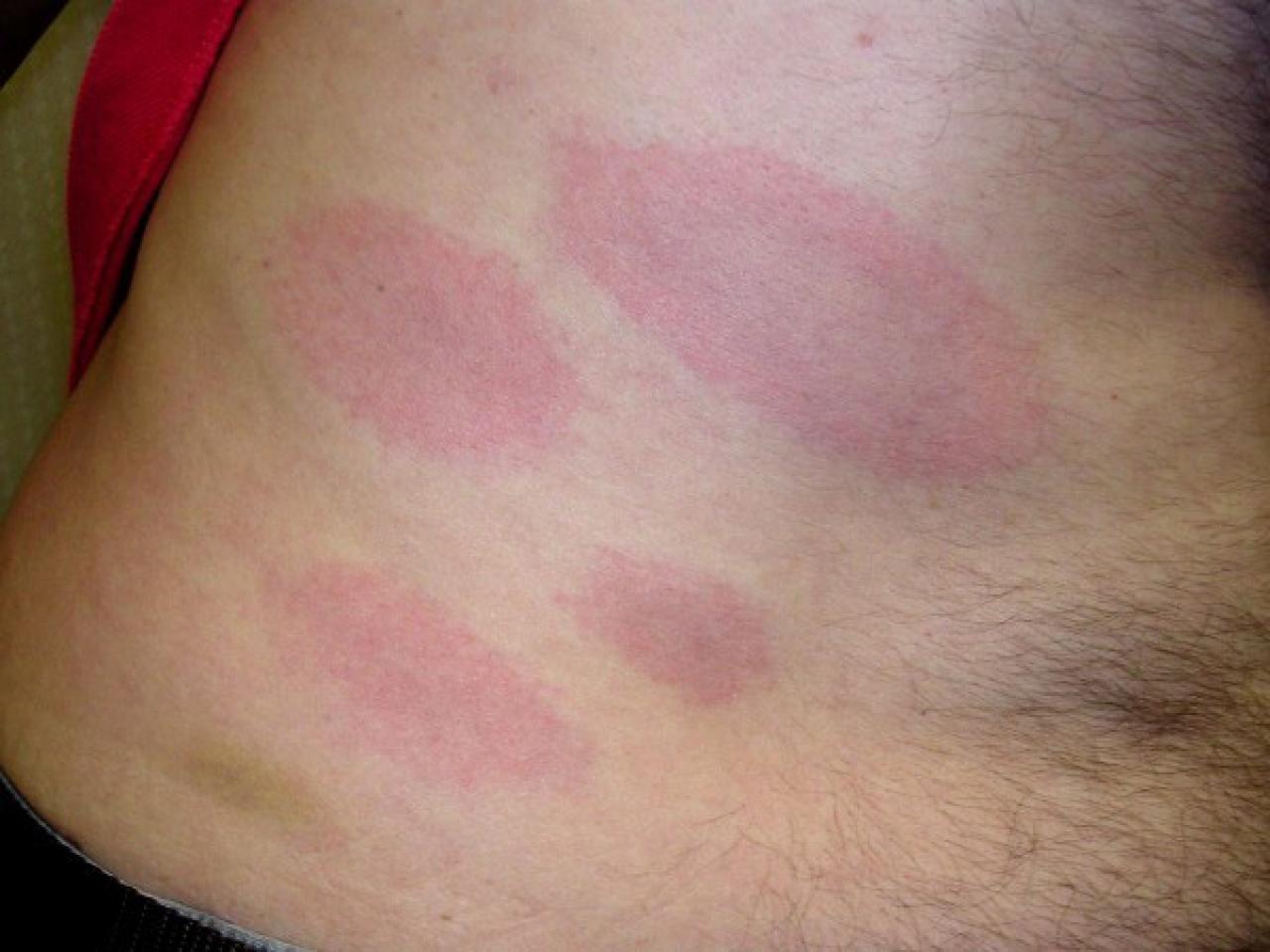
While the erythema migrans (EM) rash is the most common presentation of Lyme disease, it may not be seen in 20 to 30 percent of cases. When it does occur, it will develop at the site of the bite, usually within days to weeks. While most people know that a "target" or "bull's eye" appearance is classic for Lyme disease, many are unaware that the Bull's Eye is not the most common manifestation of the Lyme rash; in fact, only about 10-20% of EM rashes have this target appearance. The most typical appearance is a solid red or pink rash that starts small and expands to over 2 inches in size. Some EM rashes may cover an entire back. Sometimes, there are 4-8 EM rashes that appear -- confusing the doctor who is unaware that the Lyme rash may have these "satellite" rashes as well. If a small bump or red rash appears within a few hours of the tick bite, this is actually most likely a hypersensitivity reaction and not an EM rash. Acrodermatitis chronica atrophicans is a skin lesion found in Europe. This purple lesion progresses slowly typically on the extensor surface of the extremities.
Neurological
The B. burgdorferi spirochete may target the nervous system. In this case, possible conditions include meningitis, encephalitis, cranial neuritis, and radiculoneuritis.
Lyme meningitis symptoms consist of headache, neck stiffness, nausea, vomiting, light sensitivity and/or fever. Specifically, meningitis is the inflammation of the membranes covering the brain and spinal cord. A lumbar puncture or spinal tap is a helpful test to correctly diagnose Lyme meningitis. In Lyme meningitis, the cerebrospinal fluid would show an elevated number of lymphocytes, however not quite as elevated as is seen in other bacterial infections. Elevated protein levels as well as the presence of B.burgforferi-specific antibodies may also be observed. While an abnormal spinal tap is very important in confirming a case of neurologic Lyme disease, not all patients with neurologic Lyme disease will have detectable Borrelia burgdorferi in the spinal fluid. This may be because the test that is being used is insensitive or it may be because the antibodies are bound in immune complexes which prevent detection by the standard assays.
Encephalitis, inflammation of brain tissue, though possible is uncommon in Lyme disease. Patients with encephalitis may present with sleepiness, abnormal mood swings, confusion, cognitive changes, personality or behavior changes, hallucinations, or seizures. Tests that may show abnormalities include electroencephalogram with mild slowing, magnetic resonance imaging (MRI) with focal abnormalities more so in white matter than gray matter, and positron emission tomography (PET) with increased metabolism or blood flow in certain regions.
Cranial neuritis results from the inflammation of a cranial nerve, causing sensory and/or motor problems. A common manifestation of neurological Lyme disease is facial nerve palsy (also known as Bell's palsy). Facial nerve palsy often appears quickly after infection and is manifest by trouble closing eyes, an uneven smile or drooling; this is due to weakness or paralysis of the facial nerve.
Radiculoneuritis may result in motor and/or sensory symptoms and is caused by inflammation of the roots of the spinal nerve. Sensory symptoms include numbness and/or tingling as well as increased sensitivity to painful stimuli. Pain may be described as sharp, stabbing, burning, or shooting that radiates or spreads along the body.
Cardiac
Infection with B. burgdorferi may target the heart, though less commonly than with other manifestations. This can be a mild illness or a life-threatening medical emergency. A few weeks to months after initial infection, conduction abnormalities or muscular inflammation may occur. Conduction abnormalities specifically imply that the transmission of electrical signals that control the heart rate and rhythm are disrupted; this can lead to 1st or 2nd degree heart block or to a more severe 3rd degree heart block. In 3rd degree heart block, there is no conduction through the atriventricular node and that is why it is called "complete heart block".
Symptoms associated with these cardiac disturbances include lightheadedness, fainting, shortness of breath, heart palpitations, or chest pain. Patients may describe their heart as pounding or racing. While these symptoms may be benign, these symptoms may also be early signs of a soon-to-develop cardiac arrhythmia. Medical evaluation is necessary to ensure proper care is provided.
When the infection with B.burgdorferi targets the cardiac muscle, inflammation occurs and this is called "myocarditis". In this case there might be a decrease in the ability of the heart to pump with sufficient strength. Similarly, "pericarditis" is when the sac-like membrane surrounding the heart is affected.
Joints/Arthritis
Joint swelling occurs in approximately 60 percent of patients who do not get treated for Lyme disease following infection. While most often the joint swelling occurs about 6 months after the initial infection, the range of onset after infection is wide, ranging from 4 days to 2 years This means that it is often difficult for patients to remember the initial tick-bite or rash that may have occurred many months earlier.
Swelling may occur with or without pain around the joint. Typically this is a migrating mono-arthritis in which one or more large joints are affected, such as the knees, but other joints may be involved as well including ankle, shoulder, elbow, wrist, or temporo-mandibular joint. Swelling due to Lyme arthritis is often abrupt in onset and limited in duration as opposed to other forms of arthritis which tend to develop gradually and last for years. Antibiotic treatment will resolve the joint pain and swelling for most patients, however multiple courses may be required. Even after antibiotics, "antibiotic-refractory arthritis" may occur in some patients, which is considered to be an inflammatory immune-perpetuated arthritis that is no longer due to active infection. Blood tests for Lyme disease may stay positive for multiple years. To test for active infection, a PCR test of the joint fluid itself may be helpful.
Neuropsychiatric/Neurocognitive
Neuropsychiatric symptoms can be a prominent feature of Lyme disease. These may include trouble with mood, cognition, energy, sensory processing, and/or sleep. These may appear shortly after initial infection or many months later.
Cognitive deficits may include poor memory, slower speed of thinking, difficulty with word retrieval, and impaired fine motor control. "Brain fog" is a common term to describe the patient's experience. Rarely, neuropsychiatric Lyme disease results in manifestations of paranoia, hallucinations, mania, and/or obsessive-compulsive symptoms.
Patients with Lyme disease often report extreme fatigue. They may sleep 10-12 hours but not feel rested on awakening in the morning. When they exert or "push" themselves on one day, they may need the following 2-3 days to recover from the exertion. Many patients find it helpful to take a 1-2 hour nap during the day. The fatigue is like a dense blanket of exhaustion of great heaviness.
Sensory sensitivity, especially to lights and sounds may also develop during the course of infection. This can lead patients to avoid going out in the daylight, to sequester themselves at home, and to avoid shopping in stores or going to restaurants due to fear of unexpected sound sensory assaults.
Typical mood symptoms include irritability and depressed mood. Anxiety symptoms, such as prolonged panic attacks, may also develop in the course of Lyme disease.
While patients with depression who don't have Lyme disease may also experience cognitive impairment — specifically attention problems and slower thinking speed — memory deficits and verbal fluency problems are less severe in depression than in post-treatment Lyme disease.
Neuropsychiatric symptoms can emerge for a variety of reasons following an initial Lyme disease infection: inflammation, pain, interpersonal stressors, economic loss, sense of a dramatically altered future. It is important to note that because these symptoms can be disabling or life-threatening, delaying treatment of the psychiatric disorder in order to determine whether Lyme disease is the cause is not recommended. Depression ratings of moderate to severe drastically increase the rate of suicidal thoughts and risk for suicidal action. It is important for patients with prominent depressive symptoms to be under the care of a mental health provider.